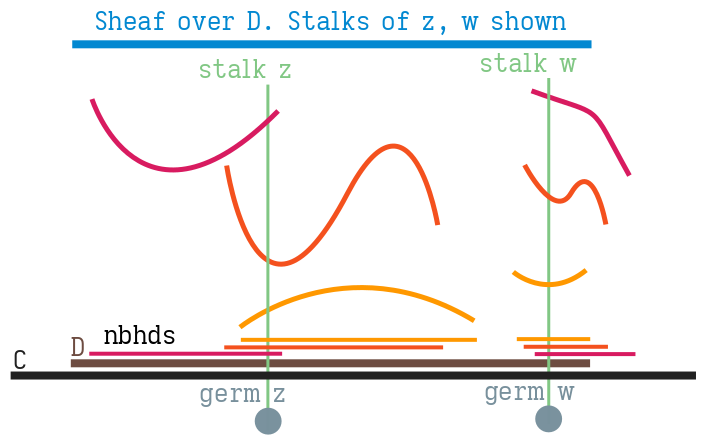
I always wanted to see sheaves in the wild in a setting that was both elementary but 'correct': In that, it's not some perverse example created to show sheaves (DaTaBaSeS arE ShEAvEs). Ahlfors has a great example of this which I'm condensing here for future reference.
§ Sheafs: Trial 1
- We have function elements . is complex analytic, is an open subset of .
- Two function elements are said to be analytic continuations of each other iff , and on the set .
- can be called as the continuation of to region .
- We will have that the analytic continuation of to is unique. If there exists a function element , such that in the region , then by analyticity, this agreement will extend to all of .
- Analytic continuation is therefore an equivalence relation (prove this!)
- A chain of analytic continuations is a sequence of such that the adjacent elements of this sequence are analytic continuations of each other. analytically continues .
- Every equivalence class of this equivalence relation is called as a global analytic function. Put differently, it's a family of function elements and such that we can start from and build analytic continuations to get to .
§ Sheafs: Trial 2
- We can take a different view, with such that is analytic at some open set which contains . So we should picture an sitting analytically on some open set which contains .
- Two pairs , are considered equivalent if and is some neighbourhood of .
- This is clearly an equivalence relation. The equivalence classes are called as germs .
- Each germ has a unique projection . We denote a germ of with projection as .
- A function element gives rise to germs for each .
- Conversely, every germ is determined by some function element since we needed to be analytic around some open neighbourhood of : Call this neighbourhood .
- Let be an open set. The set of all germs is called as a sheaf over . If we are considering analytic then this will be known as the sheaf of germs of analytic functions over . This sheaf will be denoted as .
- There is a projection . For a fixed , the inverse-image is called as the stalk over . It is denoted by .
- carries both topological and algebraic structure. We can give the sheaf a topology to talk about about continuous mappings in and out of . It also carries a pointwise algebraic structure at each stalk: we can add and subtract functions at each stalk; This makes it an abelain group.
§ Sheaf: Trial 3
A sheaf over is a topological space and a mapping with the properties:
- is a local homeomorphism. Each has an open neighbourhood such that is open, and the restriction of to is a homeomorphism.
- For each point , the stalk has the structre of an abelian group.
- The group operations are continuous with respect to the topology of .
We will pick to be an open set in the complex plane; Really, can be arbitrary.
§ Germs of analytic functions satisfy (Sheaf: Trial 3)